
MISS LEADING TOUR GUIDE

BUENOS AIRES
Where european charm meets spanish colonial architecture. This city in Argentina holds to be as the most vibrant, electric and packed with deep-rooted history. It’s a city where you can enjoy a piece of steak over couple of bottles of Malbecs, all while watching a tango performance set on a background of street graffiti with strong social messages. We arrived in Buenos Aires in late June and although the weather should not have surprised us, it certainly did. It was in the middle of their winter with temperatures much colder than what we had anticipated. After doing some extensive research on the different neighbourhoods, we decided to stay in the neighbourhood called San Telmo. It is the oldest neighbourhood in Buenos Aires. Its bohemian inner city suburb is what attracted us to stay there for five nights.
We checked in at a boutique hotel right next door to America Del Sur Hostel called Patios de San Telmo. It’s a great hotel – small, cozy and quiet with a central location.
I’m making it a point to mention America Del Sur Hostel because it is a great hostel to stay in. Its lively atmosphere and cozy interior offers a good enough breakfast bar that’s quick and tasty. There are many tours offered from this hostel.
If you don’t have much time in Buenos Aires and are a history buff, I’d recommend joining a walking tour. This will allow you to spend your time effectively while seeing and gaining a little history on all the landmarks on your bucket list. We decided to do a couple of walking tours from this hostel. We explored some monumental landmarks and learned about some important political figures like Eva Paron and Che Guevera. To my surprise, Che didn’t seem to get a lot of attention as most of his revolutionary work was outside of Argentina. However, Eva Paron and her legacy still lives on and is the heartbeat of the city.


Because Buenos Aires has so many districts, it can get overwhelming so take the time to know the different districts and what they offer. If you are staying in San Telmo, the best place for a stroll is along Calle Defensa between Avenidas San Juan and Av Independencia. Here, you can stop in to peer in the windows or go into some of the many antique shops that line the street. You can spend an afternoon or evening at Plaza Dorrego while watching professional tango performances without a stage. The streets in and around surrounding Plaza Dorrego has many vintage boutiques where you can get one of a kind gems. There is a large market just around the corner from Plaza Dorrego and inside of it you will find the best tasting empanadas. After exploring this area of town, head down to Cafe Tortoni on Av. de Mayo 825 for croissants, deserts and a coffee.
Cafe Tortoni is Argentina’s oldest cafe dating back to 1858. The architecture is phenomenal with intricate mouldings and marble table tops. The atmosphere will take you back in time.


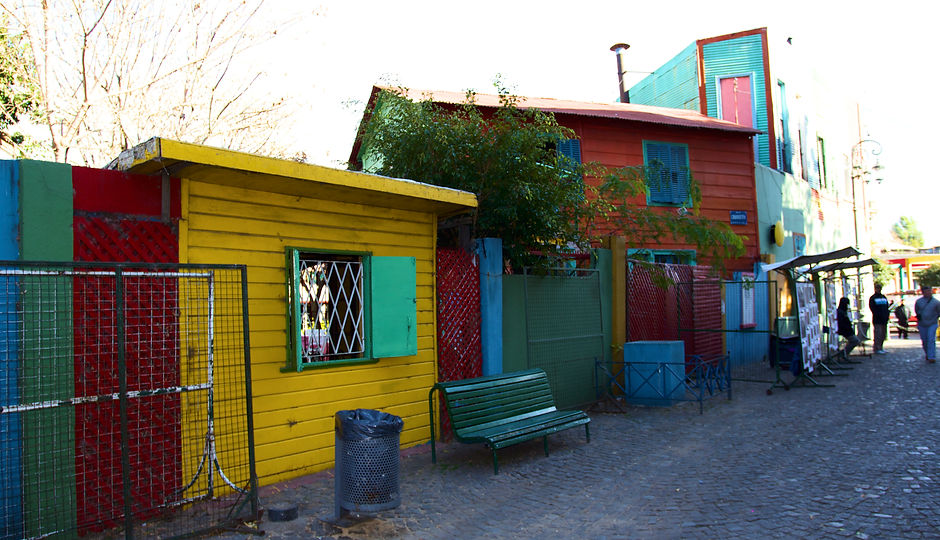
Let’s introduce La Boca, a neighbourhood that was on the top of my list. Not knowing much about the city I just thought La boca was this picturesque colourful vibrant part of Buenos Aires that’s almost always seen in postcards. Don’t get me wrong, it definitely is but it’s also very popular with tourists and crowds. Throughout time, it looks as though it has lost its history as millions of tourists flock to this place, mostly to walk up and down the touristy street Caminito. Just like everyone else, I wanted to see this so called colourful and pretty neighbourhood myself. I later learned about its deep rooted history while on a walking tour and it was absolutely astounding. Let me start by translating what La Boca means. It literally means ‘the mouth’, the mouth of the river in this case. La Boca is a part of town by the river and it’s a neighbourhood where many poor immigrant dock workers used to live. The workers were so poor that they were only able to afford to build homes from cheap corrugated thin metal sheets from the docks, which they would occasionally paint with leftover dock paint. As one colour of paint would not be enough, a different colour would be used resulting in a vibrant patchwork of colourful homes. It’s a symbol of poverty, hard work and a way of life that people from all around the world come to visit. It is best advised to go there only during the day as it is known to get dangerous at night. We then strayed away from the colourful Caminito street and went for a stroll into La Boca. It was probably not the smartest idea however, nothing eventful took place. We admired the homes in the area, barren basketball courts and not a single soul on the streets. There was something eerie about the small narrow streets here. We hurriedly walked to the main street to get our bearings back. The famous football stadium, La Bombonera is also around the corner. You can’t miss this as the streets and corners are flooded with Maradona and Messi statues and pictures. If you’re in town when the local team is playing, it’s definitely worth it to check out a game and experience the magic of football.

We had some extra time in this city, so we decided to check out another part of town. Palermo is an upscale wealthy neighbourhood that’s packed with bars and nightclubs. And of course, besides the delicious wine from Argentina there are steaks! We have eaten the most delicious steaks ever, paired with some of the best Malbecs from Mendoza. You will find many places that serve steak and there is one in particular located right in the city called La Brigada.
La Brigada serves huge portions and you can share many different dishes. We were told to go to an all you can eat steak house called Siga La Vaca right by the river. We found that it wasn’t all that delicious.
If you’ve got some more extra time, take the subway and head over to La Recoleta, a famous cemetery. Try to find Eva Perone’s stone there. It’s the one where every tourists flocks to, but it could also be tough to find since the cemetery is a total maze!
A day trip to Uruguay could be the perfect way to end your trip in Buenos Aires. If Mendoza is on your list, set aside a few days for that trip for the Malbecs and the mountains. Since we just had a day to spare, we took a ferry to Colonia del Sacramento, Uruguay for the day and explored this small quaint city. Remember to bring your reciprocity fee paper as you will be exiting Argentina. Without it, you will not be able to enter Argentina. We forgot ours and yes, we only realized when we were in Uruguay. This left us scrambling to find a shop with a computer and printer so we could access our email and print it. We got lucky enough to find a small shop with a computer desk behind a curtain.
Now, being at a more relaxed state, we stopped in for a coffee and some ice-cream at Freddo and people watched until we had to catch our ferry back to Buenos Aires.

